




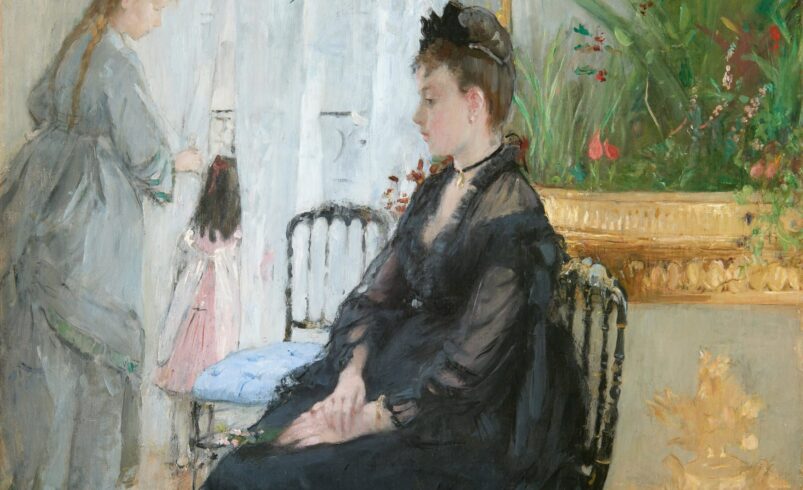
An exhibition sets out to rescue Morisot from the assumption that she was under Manet’s influence, but it’s far from academic or revisionist.
SAN FRANCISCO Manet & Morisot at the Legion of Honor is a somewhat scholarly exhibition on the lives, work, and friendship of two eminent French 19th-century artists. While it sets out to rescue Berthe Morisot from a long held assumption that she owed her art to the influence even guidance of Édouard Manet, the show is far from an academic or revisionist experience. Instead, after seeing their work compared and contrasted across a handful of galleries, the word that comes most immediately to mind is “pleasure.”
That Manet could really paint is no surprise. He’s sometimes called the “father of Modernism,” a figure at least as pivotal as Cézanne. The surprise here is how much Morisot’s work holds its own alongside his, and how much Manet understood that himself.
The two first met in the mid-1860s at the Louvre, where artists often made copies after works in the collection. Berthe was there with her older sister, Edma, also an artist, accompanied by their mother as their necessary chaperone. (As a man, Manet did not, of course, require a chaperone.) Though he was married, nearly a decade her senior, and already known for scandalous paintings — see “Le Déjeuner sur l’herbe” and “Olympia” (both 1863) they struck up a friendship. By 1868, Morisot had posed as the brooding central figure in Manet’s large canvas, “The Balcony” (1868). It’s likely at this point that she gets cast as his student and his muse.
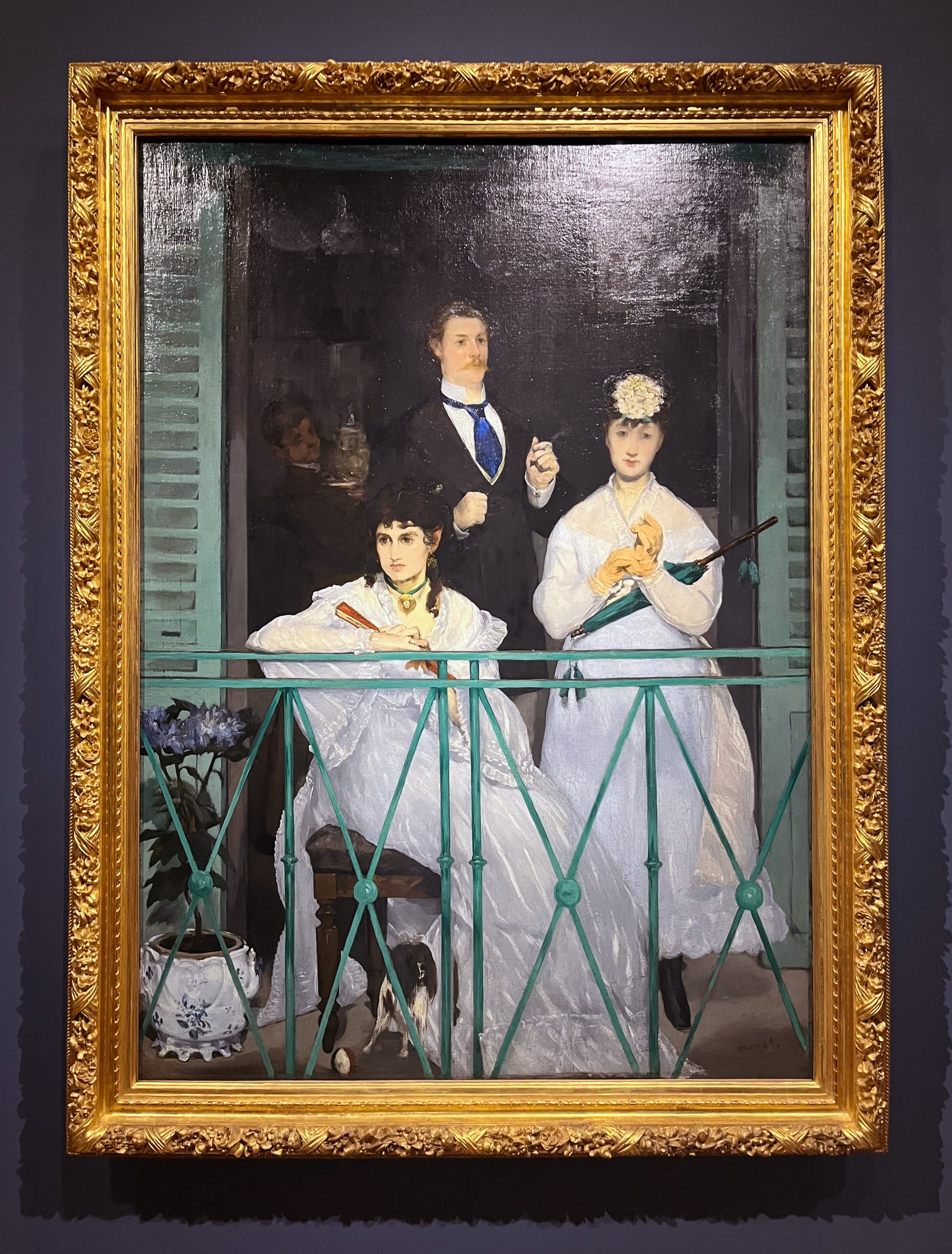
Morisot was a formidable, compelling figure, and Manet was clearly compelled by her. In “The Balcony,” Morisot’s dark hair, brows, and intensely focused gaze are a dramatic counterpoint to her feathery white dress, closed fan clasped in her pale hands, and the little dog at her feet. But though she may have been something of a muse early on, she was never Manet’s student, and in fact reacted with fury when he once “corrected” something in one of her paintings.