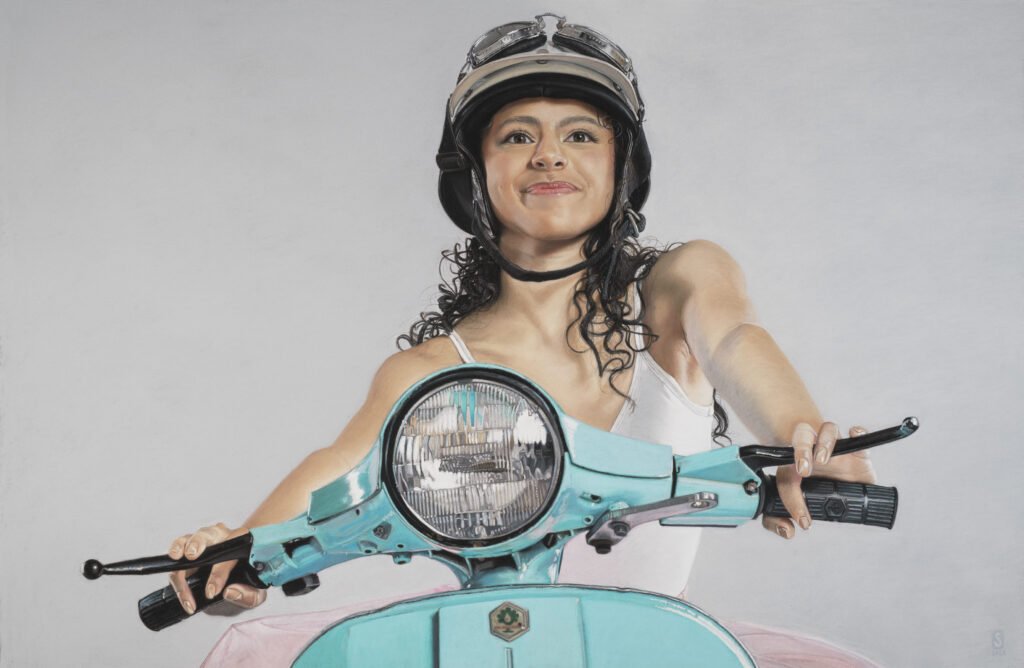
Portraiture has always carried an uneasy double burden: to record what someone looks like, and somehow, simultaneously, to suggest who they are. Most portraits fail at the second task even when they succeed at the first. The work of Mexican artist Sylvianne Blum Cassereau is worth examining precisely because it takes that second, harder task seriously.
A Medium Chosen for Its Limits
Blum Cassereau works primarily in soft pastel, a medium whose apparent limitations turn out to be central to her achievement. Pastel offers no intervening tool between hand and surface; pigment meets paper through direct contact, layer built upon layer, with limited capacity for correction or concealment. This immediacy imposes a discipline on the artist that shows in the finished work: decisions about color and form must be made with confidence, since pastel does not forgive extended hesitation the way oil sometimes can.
The result is portraiture with a certain rawness beneath its polish, a sense that each mark records an actual decision rather than an accumulation of adjustments smoothed over time.
The Problem of the Gaze
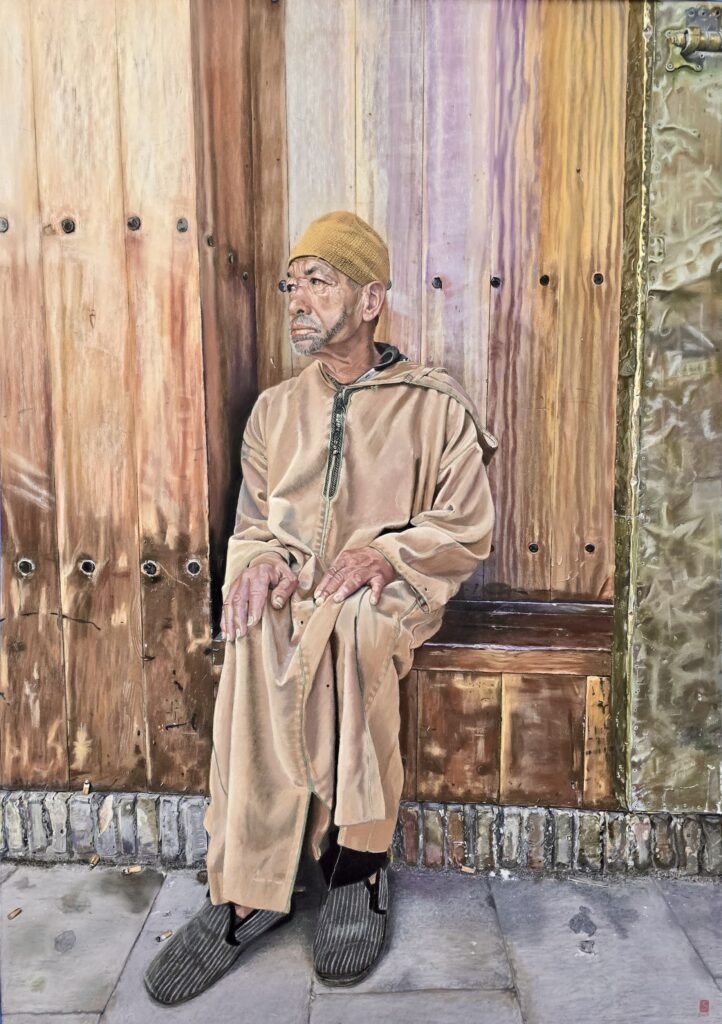
Any critical reading of Blum Cassereau’s work has to reckon with her treatment of the eyes, which function as the compositional and emotional center of nearly every piece. This is not an unusual choice in portraiture generally, but her execution of it deserves attention. She resists the temptation, common in decorative portrait painting, to render eyes as symmetrical, glossy focal points detached from the rest of the face. Instead, they emerge from the same layered, textured pastel work as the surrounding skin connected rather than isolated, embedded in a specific face rather than floating above it.
This matters because it is precisely through this integration that her portraits achieve what she describes as their aim: moving beyond physical representation toward the sitter’s underlying strength, sensitivity, and essence. The gaze is not a special effect added atop the likeness; it grows organically from the same patient process that built everything else.
Skin as Structural Argument
Equally significant is her handling of skin, rendered not as a uniform field of color but through careful attention to its nuances variations in tone that map light, age, and the particular history of a given face. This attentiveness carries an implicit argument: that individuality lives partly in these small, easily overlooked variations, and that flattening them into generic smoothness would constitute a kind of erasure.
In this sense, her technical choices align closely with her stated artistic values. A practice centered on the worth and dignity of the individual person could hardly justify painting skin as an undifferentiated surface. The nuance she builds into flesh tones is not merely technical virtuosity; it is consistent with the ethical premise underlying her entire project.
Sourced From the World, Not the Studio
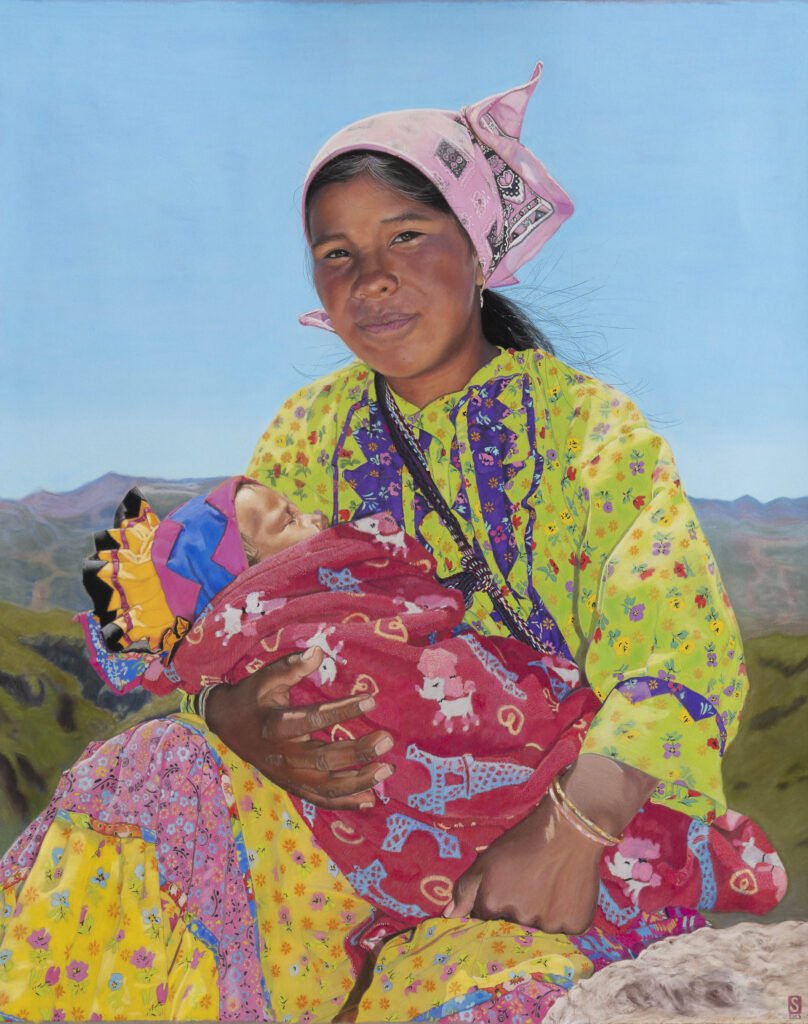
Unlike portraiture built on staged sittings, Blum Cassereau’s subjects originate in travel encountered through observation and captured through her own photography before ever reaching the studio. This sourcing method shapes the character of the resulting work. These are not idealized compositions constructed to flatter; they are interpretations of actual people, encountered in actual places, whose specific presence the artist felt compelled to preserve.
That distinction matters critically. Portraiture drawn from life, however mediated by photography and memory, tends to resist the generic in ways that invented or composite imagery often cannot.
Reception on an International Stage
Blum Cassereau’s work has circulated through exhibitions and art events spanning New York, Barcelona, Madrid, Zaragoza, Venice, Rome, Cannes, Cortona, Perugia, Punta del Este, Taipei, and Hong Kong, alongside features in international art books and magazines and recognition through selections and distinctions in art competitions. This range of contexts spanning distinct artistic traditions and audience expectations suggests a body of work legible across cultural boundaries, likely because its central subject, human dignity rendered through careful observation, translates without requiring shared cultural reference points.
An Unfinished Argument
What ultimately distinguishes Sylvianne Blum Cassereau’s contribution to contemporary portraiture is not a single technical innovation but a sustained, coherent argument carried out across an accumulating body of work: that a face, rendered with sufficient patience and attentiveness, can gesture toward something beyond its own physical boundaries. Whether that gesture fully succeeds remains, appropriately, a question each viewer must answer for themselves, standing before the work. But the seriousness of the attempt visible in every layered, carefully considered surface is not in dispute.
Discover more of her work: Sylvianne’s art and portraits on Instagram