Top Ten lists that appeared in the December 2025 issue (in which curators and other professionals highlight their favorite exhibitions of the year) with our own Editors’ Picks of superlative shows.
01
John Zorn (The Drawing Center, New York)

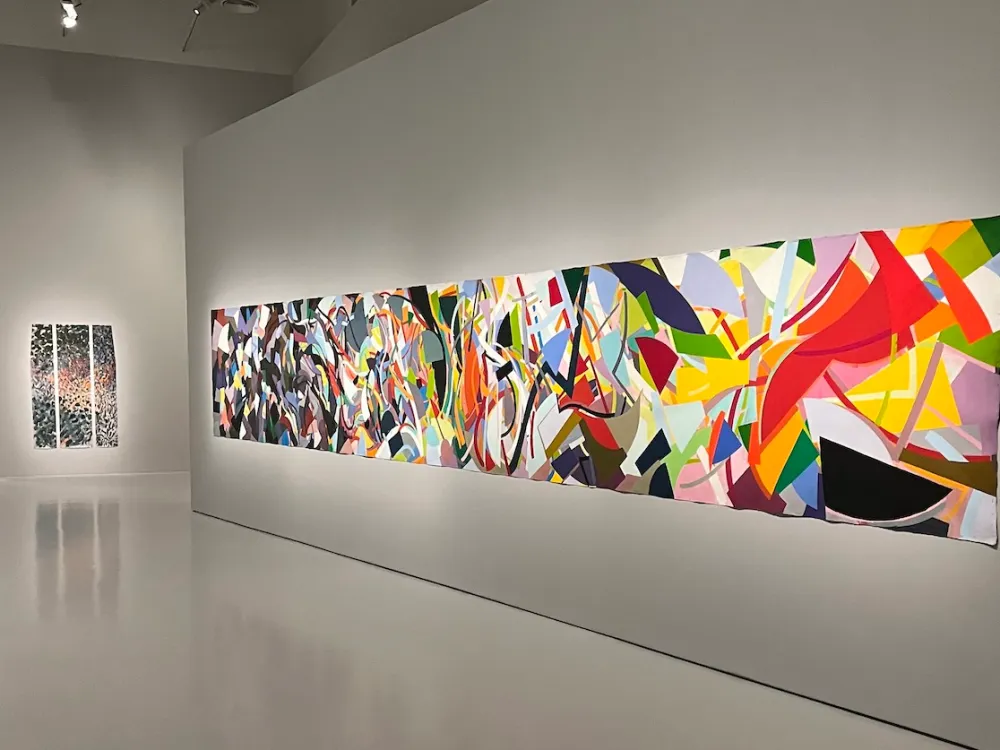
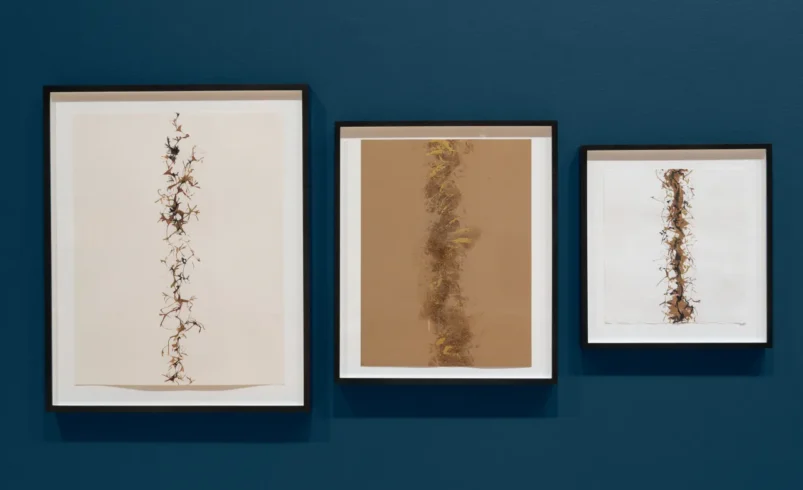
View of “John Zorn: Hermetic Cartography,” 2025, The Drawing Center, New York. Photo: Daniel Terna.
With one great show after another, the Drawing Center has been on a roll lately, but my favorite was by an artist I hadn’t even realized was one. Of course I know John Zorn’s music some small portion of it, anyway, since he’s too prolific for me to keep up with so I went to the show “Hermetic Cartography” assuming I’d be seeing graphic scores and the like. There were a few of those, along with notebooks and designs for concert flyers, but the heart of the show was a compendium of abstract works in a multitude of techniques attesting to an inspiringly fertile visual imagination.
02
Lisa Yuskavage (The Morgan Library & Museum, New York)

Lisa Yuskavage, Piggyback Ride, 2009, charcoal and pastel on paper. Installation view, “Lisa Yuskavage: Drawings,” The Morgan Library & Museum, 2025–6. Photo: Daniel Terna.
Lisa Yuskavage’s works are discomfiting in the most voluptuous possible way. Her debut exhibition in 1993 convinced me that “to analyze them thoroughly would probably be something like psychoanalyzing oneself in public”, and I think I’ve finally done that in an essay for her imminently forthcoming Phaidon monograph, but the charge I get from her blend of luxuriant color, profligate form, and ambivalent sensuality remains more visceral than analytical. The intimacy of drawing allowed this works on paper retrospective at the Morgan, curated by Claire Gilman, to show Yuskavage’s art at peak intensity.
On view through January 4, 2026.
03
Lucas Arruda (Musée d’Orsay, Paris)

View of “Lucas Arruda: Qu’importe le paysage,” 2025, Musée d’Orsay, Paris. Photo: Nicolas Brasseur.
If John Constable could have been influenced by Mark Rothko, the results might have turned out something like the paintings of Lucas Arruda. My view of the Brazilian painter as a radical traditionalist was confirmed by his exhibition at the Musée d’Orsay, “Qu’importe le paysage” (roughly, “What’s the big deal about landscape?”), in which some thirty of his works all imaginary landscapes reduced to the minimum, were exhibited alongside nineteenth-century paintings from the museum’s collection: Courbet, Monet, Pissarro, and others. Like many of them, he sites his work at the intersection between the materiality of paint and the impalpable phenomenology of light.