


Josep Maria Fontanet Sureda is a contemporary Spanish painter whose artistic practice is rooted in a deeply personal exploration of realism, light, atmosphere, and the changing nature of reality. Born in Barcelona, Spain, in 1955, Fontanet Sureda has developed a distinctive body of work that moves between objective observation and imagined or virtual realities.
At the center of his current artistic practice are three recurring subjects: water, light, and the passage of time. These elements provide him with endless opportunities to investigate the visual world and the elusive qualities that often remain hidden beneath ordinary appearances.
For Fontanet Sureda, painting is an act of searching. His work is driven by a desire to capture the essence of things through the light they reflect to reveal the hidden beauty of familiar environments and communicate the mystery that exists between illumination and darkness.
His paintings demonstrate a careful balance between technical precision and emotional sensitivity. While accuracy is important to his practice, he does not seek realism for its own sake. Instead, he uses realism as a means of conveying atmosphere, emotion, and the subtle poetry of everyday life.
The Obsession With Light
Light is perhaps the most important element in Josep Maria Fontanet Sureda’s artistic world. His fascination extends beyond natural illumination to include the particular qualities of electric light, reflected light, and the subtle transitions between brightness and shadow.
He is interested in how light transforms the things around us. A familiar room can become mysterious when illuminated by a single lamp. A window can filter the glow of a bulb, creating unexpected patterns and atmospheric effects. The gloom of sunset can change an ordinary landscape into something contemplative and almost otherworldly.
These moments of transformation are central to his artistic investigation.
Fontanet Sureda seeks to capture the atmosphere created by light rather than simply reproduce the objects it touches. His paintings therefore become studies of perception, encouraging viewers to consider how much of what we see is shaped by illumination.
The result is a body of work in which light becomes almost a subject in itself.
Water, Reflection, and the Passage of Time
Water is another recurring focus in Fontanet Sureda’s recent work. Like light, water is constantly changing. Its surface reflects, distorts, and transforms the world around it, making it an ideal subject for an artist interested in perception and the passage of time.
Water also carries a sense of movement and impermanence. A reflection may exist for only a moment before disappearing. The surface changes with every movement, while light continuously alters its appearance.
Through his exploration of water, Fontanet Sureda examines the relationship between permanence and change. The paintings capture moments that appear still while suggesting that everything is constantly moving.
This interest in time extends throughout his artistic practice. His paintings often seem to exist between one moment and the next, preserving an instant while reminding the viewer that the instant itself is fleeting.
Realism Without Losing Emotion
Fontanet Sureda’s approach to realism is both technically careful and emotionally sensitive. He seeks accuracy, but he does not want precision to eliminate feeling.
This balance is central to his artistic philosophy. A painting can be visually accurate while still retaining mystery, emotion, and ambiguity.
His use of color plays an important role in achieving this balance. Rather than treating color simply as a tool for reproducing reality, he uses it to create atmosphere and emotional depth.
Through careful observation, he searches for what he describes as the hidden beauty of things the qualities that might be overlooked in everyday life but become visible when we take the time to truly observe.
His paintings encourage viewers to look more closely at the ordinary, revealing how light and color can transform familiar spaces and objects into subjects worthy of contemplation.
Between Objective and Virtual Reality
One of the most fascinating aspects of Fontanet Sureda’s practice is the way it moves between different forms of reality.
His work can be objective, grounded in careful observation of the physical world. At other times, it becomes virtual, imagined, or deliberately ambiguous.
These seemingly different approaches are not contradictions for the artist. Instead, they form part of a larger artistic unity.
Fontanet Sureda explores the idea that reality itself can be understood in different ways. What appears real may be influenced by memory, imagination, technology, or perception. Similarly, something that seems imaginary can sometimes reveal truths about human experience.
This philosophical interest has led him to develop parallel artistic projects with distinct visual aesthetics, each allowing him to explore different forms of pictorial truth.
The Search for Pictorial Truth
Fontanet Sureda’s artistic practice is driven by a desire to discover what might be called pictorial truth.
In one direction, he searches for truth through a highly personal form of realism. In another, he explores truth through fantasy and false reality.
At first, these approaches may appear to be opposites. However, for Fontanet Sureda, they are connected by the same fundamental question: how can painting reveal something that lies beyond appearances?
The answer does not necessarily come through literal representation. Sometimes, a painting can communicate truth by creating an illusion, suggesting an imagined world, or presenting an ambiguous scene.
This tension between what is real and what is constructed gives his work a philosophical dimension.
“Un dia qualsevol” and the Virtual World
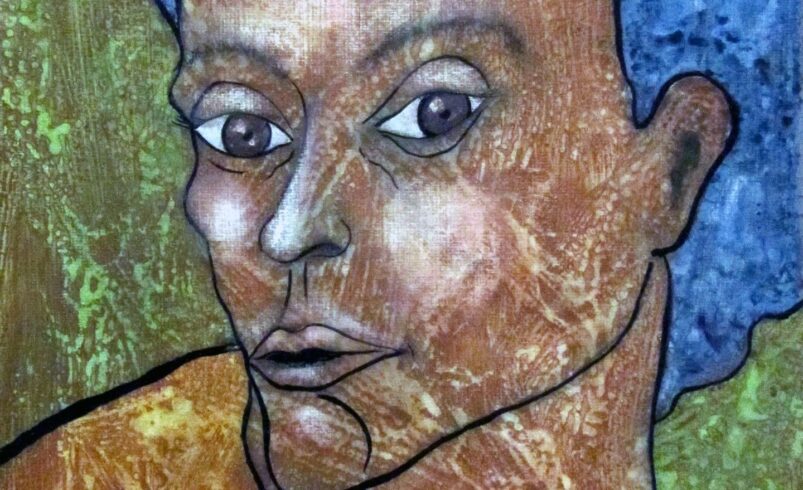
This exploration of reality takes a particularly contemporary form in Fontanet Sureda’s series “Un dia qualsevol.”
The paintings in this series emerge from the virtuality created by social and technological change. They reflect a world increasingly shaped by digital communication, virtual interactions, and new forms of social connection.
The works are populated by characters whose relationships and interactions remain mysterious. The viewer may observe the figures, but the exact nature of their connections is not always clear.
This ambiguity is deliberate. The characters become intuitions about social transformation, reflecting a world in which human relationships are increasingly mediated by technology.
Rather than offering a definitive interpretation, Fontanet Sureda creates situations that encourage viewers to question what they are seeing. Who are these people? What connects them? What is happening beyond the visible scene?
The uncertainty becomes part of the artwork’s meaning.
A Contemporary Reflection on Human Experience
Through “Un dia qualsevol,” Fontanet Sureda demonstrates how painting can respond to changes in contemporary society while remaining connected to the traditions of figurative art.
His work recognizes that technology has transformed not only how people communicate but also how they experience reality itself.
The virtual world has introduced new spaces of interaction, new forms of identity, and new questions about what it means to be present. Fontanet Sureda explores these developments through mysterious scenes that leave room for interpretation.
His paintings therefore operate on multiple levels. They can be appreciated for their visual qualities and technical precision, but they also encourage deeper reflection on the changing nature of human relationships.
Painting the Space Between Light and Darkness
Born in Barcelona in 1955, Josep Maria Fontanet Sureda has developed an artistic practice that continually searches for the point where reality becomes uncertain.
His paintings explore water, light, time, color, reflection, technology, and human interaction. Through realism, fantasy, and virtual imagery, he examines the many ways in which people perceive and understand the world.
At the heart of his work is an enduring fascination with light. Whether it is the glow of an electric bulb, the filtered illumination entering through a window, or the fading light of sunset, he seeks to preserve the atmosphere of fleeting moments.
His art reminds us that reality is never entirely fixed. Light changes, water moves, time passes, and human relationships evolve.
Through his paintings, Fontanet Sureda captures these transformations with remarkable sensitivity, seeking accuracy without sacrificing emotion and realism without losing mystery.
Ultimately, his work invites viewers to pause before the familiar and see it differently to discover beauty in ordinary moments, question the boundaries between reality and imagination, and contemplate the mysterious space that exists between light and darkness.