


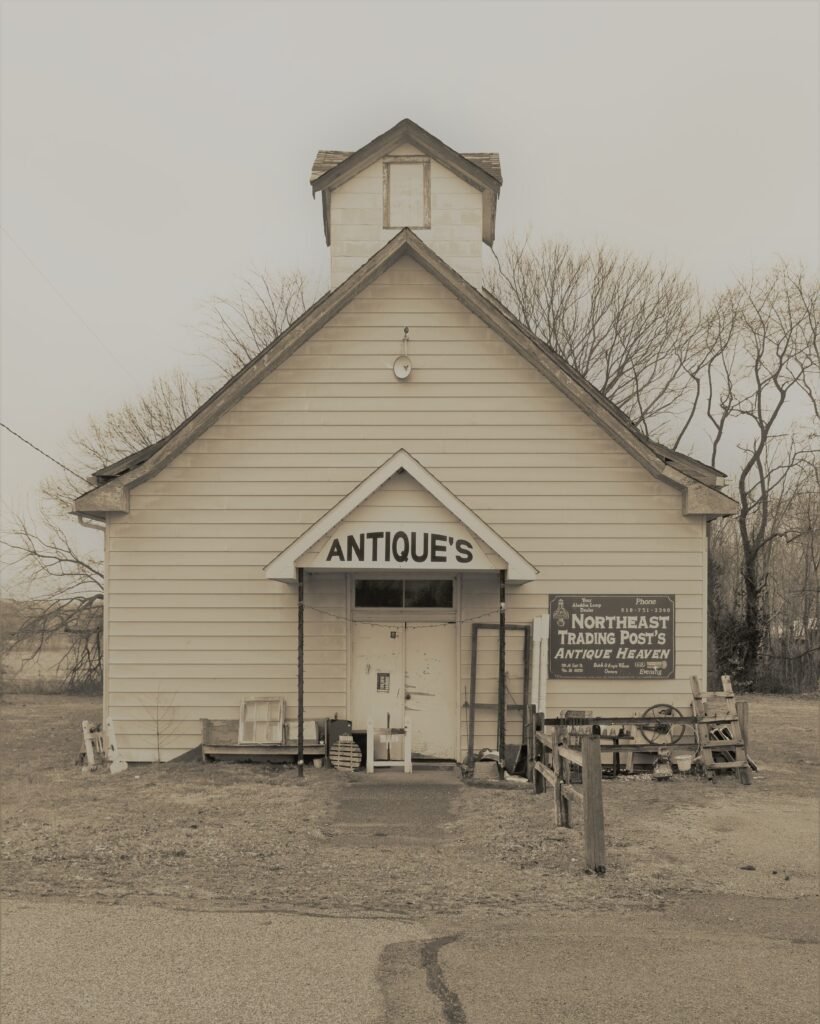
Michael Aldag has built his photographic practice on a simple but demanding premise: pay close attention to the place you’re from. For Aldag, that place is Southern Illinois, a region he was born and raised in and one that continues to shape how he sees. His recent work, a series titled Temple, asks viewers to look at something easy to overlook: the empty husks of buildings that used to be churches. The series is quiet, patient, and more interested in raising questions than answering them.
Seeing From Inside a Place
There’s a difference between photographing a region as an outsider and photographing it as someone who grew up inside it. Aldag’s work belongs to the second category. His images of the Midwest landscape don’t reach for the picturesque, and they don’t frame Southern Illinois as scenery to be admired from a passing car. Instead, they carry the flat, weathered familiarity of a place someone has actually lived in, driven through a thousand times, and watched change slowly over years.
That familiarity comes through most clearly in tone. Aldag’s photographs tend toward the somber: muted light, restrained color, a stillness that borders on melancholy without tipping into sentimentality. It’s a visual register suited to a region defined less by dramatic landmarks than by long stretches of farmland, small towns, and the buildings those towns leave behind as populations shift and shrink. This is the landscape Temple grows out of.
Why a Church, Empty
A church building carries a specific kind of architectural intention. It’s constructed to hold people, to organize their attention toward something shared, to mark a town’s center in ways that outlast any single congregation. When that building empties out, the structure doesn’t simply become vacant real estate. It becomes a kind of question mark standing in the middle of a landscape that used to make sense of it.
That’s the territory Aldag works in with Temple. He isn’t documenting ruins for their picturesque decay, nor is he making an argument about religion in decline. What his photographs do is hold the buildings still long enough for a viewer to notice the gap between what a structure was designed to be and what it has become. The titles he gives individual works push gently in this direction too, often pointing past the physical facts of the image toward something less literal.
Quiet Bell: A Building in Iuka
The clearest entry point into this project is Quiet Bell, a 2025 photograph printed as a 16 by 24 inch metal print. It shows what was once Bell Missionary Baptist Church, located in rural Iuka, Illinois. Like a number of former church buildings across Southern Illinois and elsewhere in the country, the structure has since been abandoned.
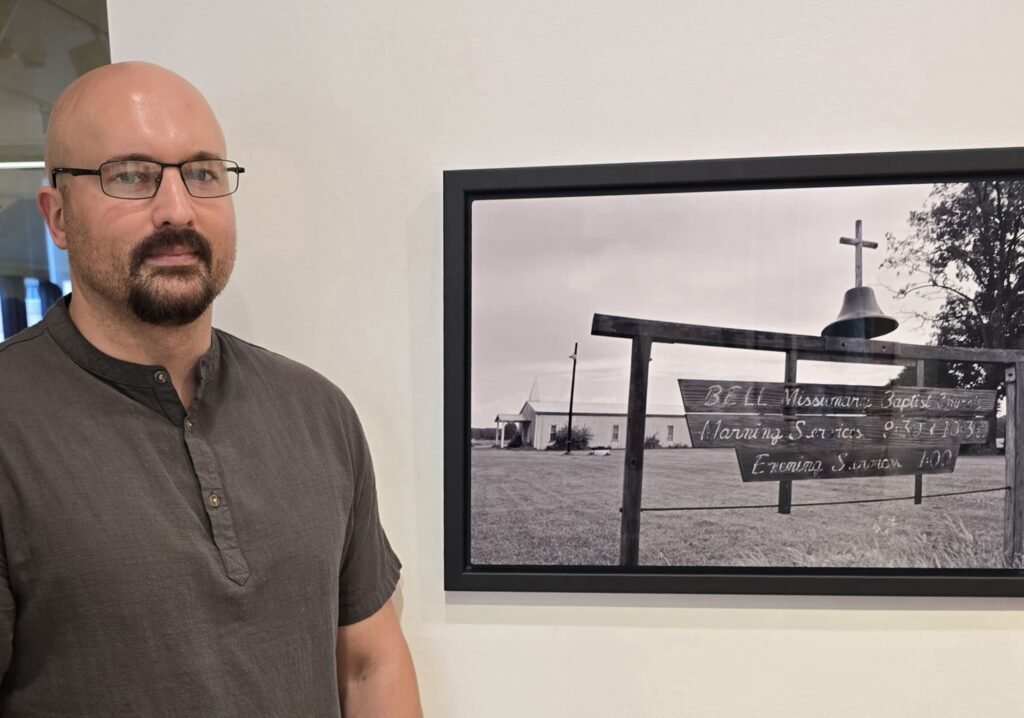
The title does more work than it might first appear to. A bell is an instrument of summons, built to call a scattered community into one place at one time. A quiet bell is a bell that no longer does this. Whatever it once signaled, it no longer signals. The photograph doesn’t dramatize that silence, and it doesn’t need to. The building itself carries the weight, standing where it has always stood, doing none of the things it was built to do.
It would be easy to read a photograph like this as a statement about loss, but Aldag’s approach seems more interested in leaving that reading open. What does it mean for a town when its church closes? What does it mean for the people who once gathered there, and for the ones who never will? Quiet Bell doesn’t answer these questions. It simply makes them harder to avoid.
An Object, Not a Copy
One of the more distinctive aspects of Aldag’s practice is how he treats the printed photograph itself. Each finished piece is a one-of-a-kind object. He doesn’t produce multiples of a single image, which means owning a Temple photograph means owning the only version of it that exists.
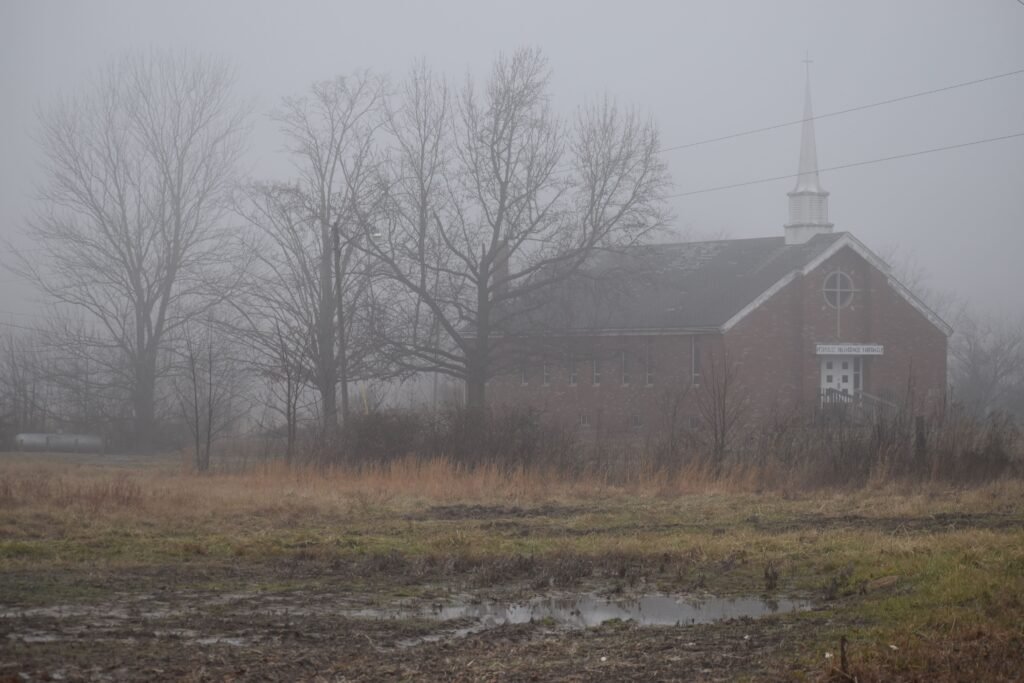
This extends to material as well. Depending on the work, Aldag prints on paper, metal, fabric, or glass, and each surface changes the character of the image. A metal print like Quiet Bell holds a certain coolness and permanence, qualities that seem fitting for a photograph of a structure built to last generations and now standing empty. A fabric or paper print might carry a softer, more fragile presence. The material isn’t just a production choice. It becomes part of how each photograph communicates.
Recognition Beyond the Region
Aldag’s work has found audiences beyond Southern Illinois. His work has appeared in juried exhibitions in Illinois, Arizona, and Ohio, along with international online competitions, a track record built alongside the development of Temple itself. Quiet Bell in particular was selected for the 2026 Illinois All-State Art Exhibition at the Giertz Gallery in Champaign, Illinois, placing the photograph and the questions it raises in front of a broader audience.
His work can also be purchased directly through the Illinois State Museum in Springfield, Illinois, an institution with its own stake in preserving the visual record of the state. It’s a fitting home for photographs so concerned with what gets remembered and what gets left to fade.
What Remains When the Purpose Is Gone
There’s a particular kind of attention required to look closely at a building most people would drive past without noticing. Michael Aldag’s Temple series asks for exactly that kind of attention, turning the overlooked architecture of Southern Illinois into photographs that hold still long enough to be considered. A closed church is not just an empty structure. It’s a marker of change, a physical trace of a community that used to gather in one place and, for whatever reason, no longer does.
Aldag doesn’t resolve what that change means. He doesn’t need to. By making each photograph a singular object rather than a mass-produced print, and by choosing materials that give each image its own physical presence, he treats these buildings with a seriousness that matches their original purpose, even after that purpose has disappeared. What’s left, in the end, is a set of images that ask viewers to look again, and to sit a little longer with what a landscape holds onto after the reason for it has moved on.
Prints, Purchase, and Where to Follow the Work
Those interested in owning a piece of the Temple series, or in following Aldag’s photography more broadly, can find his available prints through the Illinois State Museum Shop in Springfield, Illinois. His full body of work and updates on current projects are also viewable online.
Website: https://michaelaldag.carbonmade.com/ Facebook: https://www.facebook.com/MichaelAldagFineArtist Illinois State Museum Shop: https://shop.illinoisstatemuseum.org/