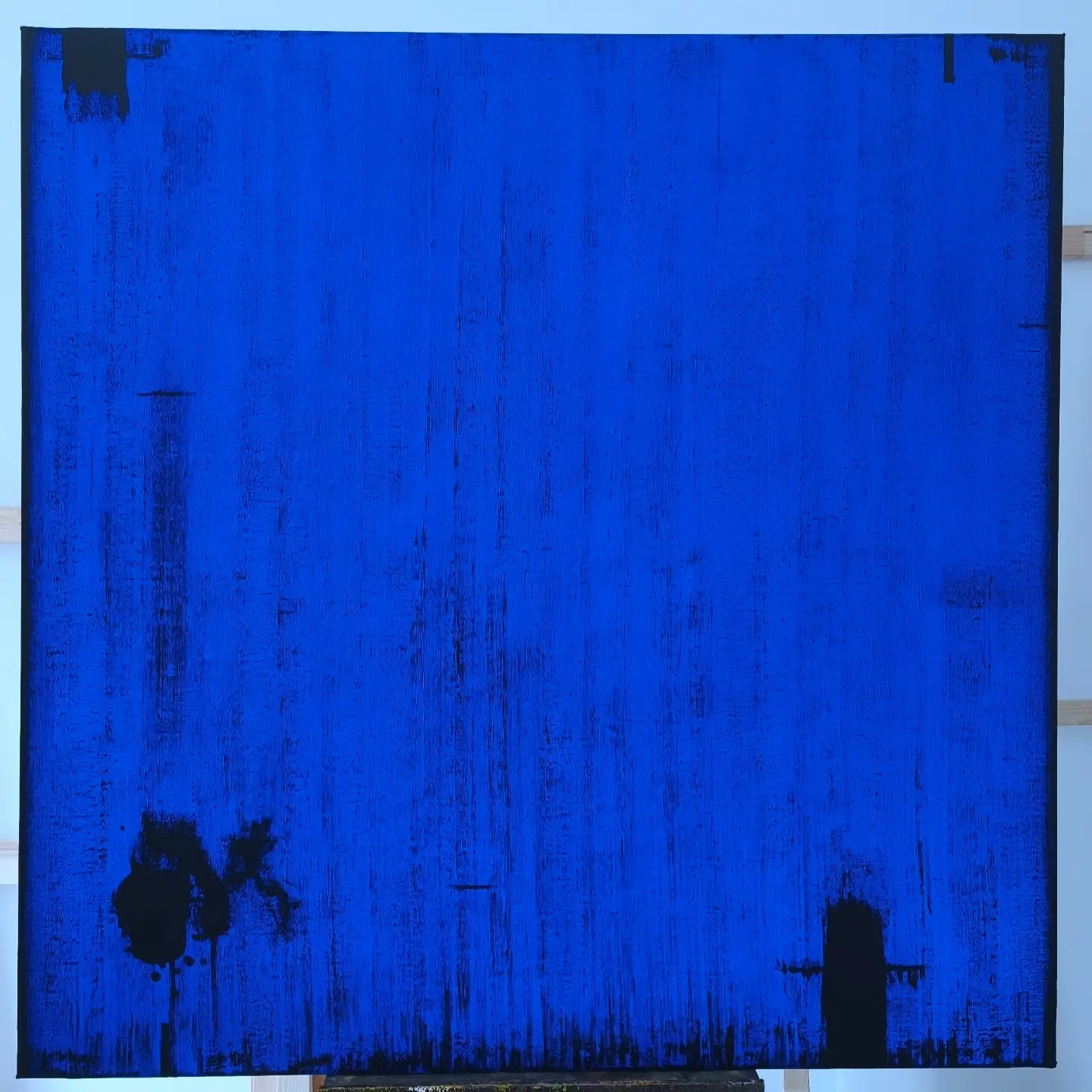
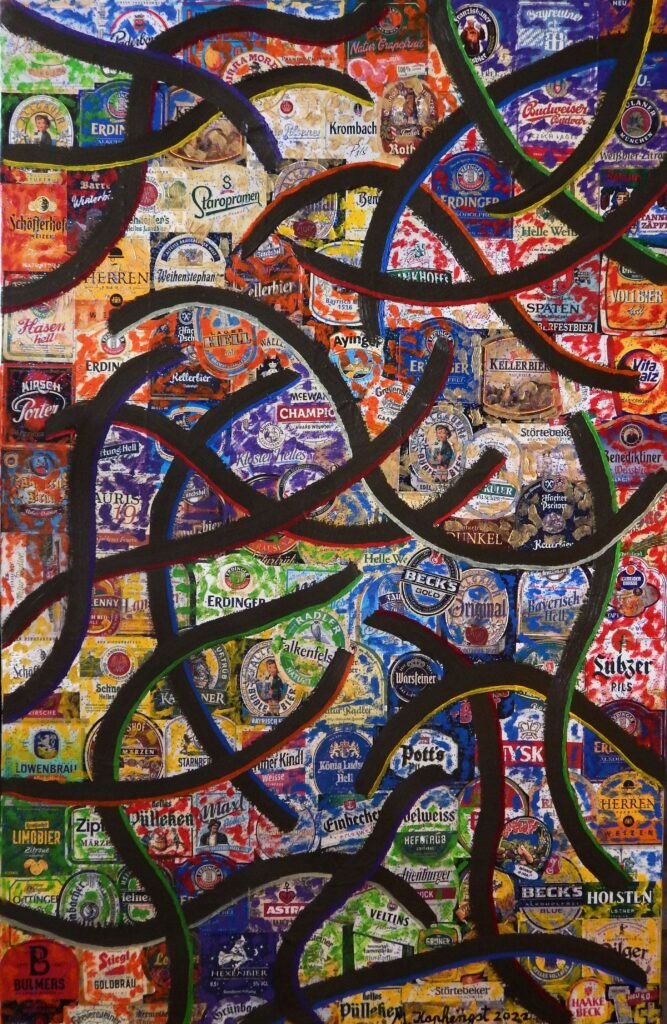
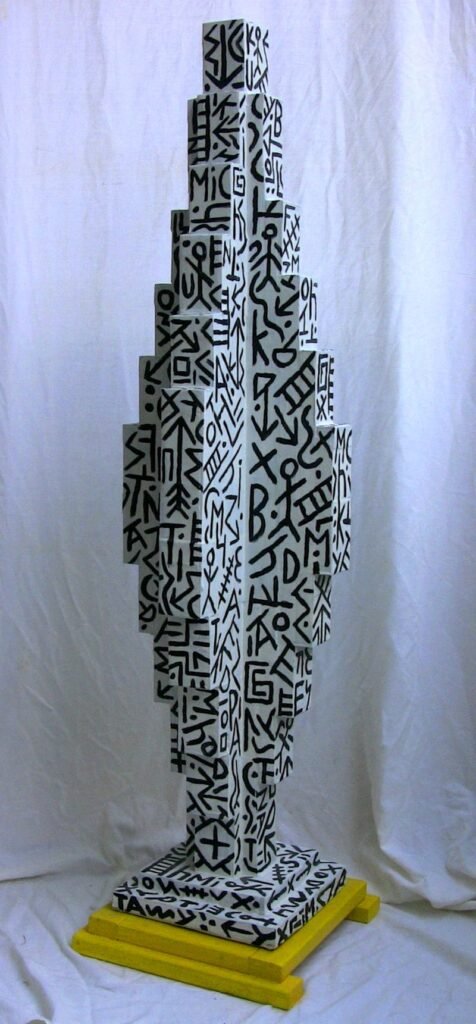
Some artists arrive at their signature ideas through study alone. Michael Kaphengst arrived at his through a fencing foil, a roll of set-marking tape, and years spent behind a bar on Hamburg’s Reeperbahn. The German artist’s work revolves around a single, evolving idea the line, not as a boundary but as the basic material of an image, and around a recurring theme: that consumption is not a passing cultural trend but a linear, repeating process none of us fully escape. Across four related bodies of work Linearism, Consumptive Surrealism, Fencing Pictures – Absolute Linearism, and Extreme Linearism Kaphengst has built a practice that treats everyday objects, physical movement, and discarded materials as legitimate subjects for serious art.
The Line as Building Block, Not Boundary
Most artists use a line to define where a shape ends. In 1995, Kaphengst inverted that logic with Linearism, a method in which entire images dissolve into networks of colored lines. The line stops being a tool for outlining and becomes the image’s fundamental unit, closer to a brick than a border. It’s a conceptually simple shift, but it opened a vocabulary he would return to and intensify for the next two decades, each new body of work pushing the idea further into physical and conceptual territory.
Consumer Objects in Strange Company
Kaphengst’s fascination with Salvador Dalí and Surrealism gave him an early interest in dreams and the subconscious, but his own contribution Consumptive Surrealism turned that lens toward something more mundane: the consumer product. Ordinary goods, placed in unexpected and unsettling contexts, become vehicles for examining how thoroughly consumption structures everyday perception. His training as a graphic designer in Minden, begun in 1993, and his parallel study of modern art history alongside a growing interest in Pop Art, gave the idea both a formal grounding and a visual language distinct from Pop Art’s more celebratory relationship to consumer culture. Where Pop Art often flattens and elevates the product, Kaphengst’s Surrealist inflection makes it strange again.
Discarded Materials as Raw Subject Matter
That interest in consumption extends to what gets thrown away. A casual scene in a student residence in Minden empty cigarette packets being tossed between students became a catalyst, prompting Kaphengst to see discarded packaging as sculptural material worth serious attention. The instinct recurred later in Hamburg, where his internship at Studio Hamburg put him in contact with colored adhesive tape, used on set purely to mark actors’ positions for camera and blocking. He began treating it instead as a line, a plane, a trace an artistic material with its own history, since it was freely available and steeped in the functional language of film production. Both instances point to a consistent habit: taking material meant to be temporary or invisible and giving it permanence and visibility.
The Body as Instrument
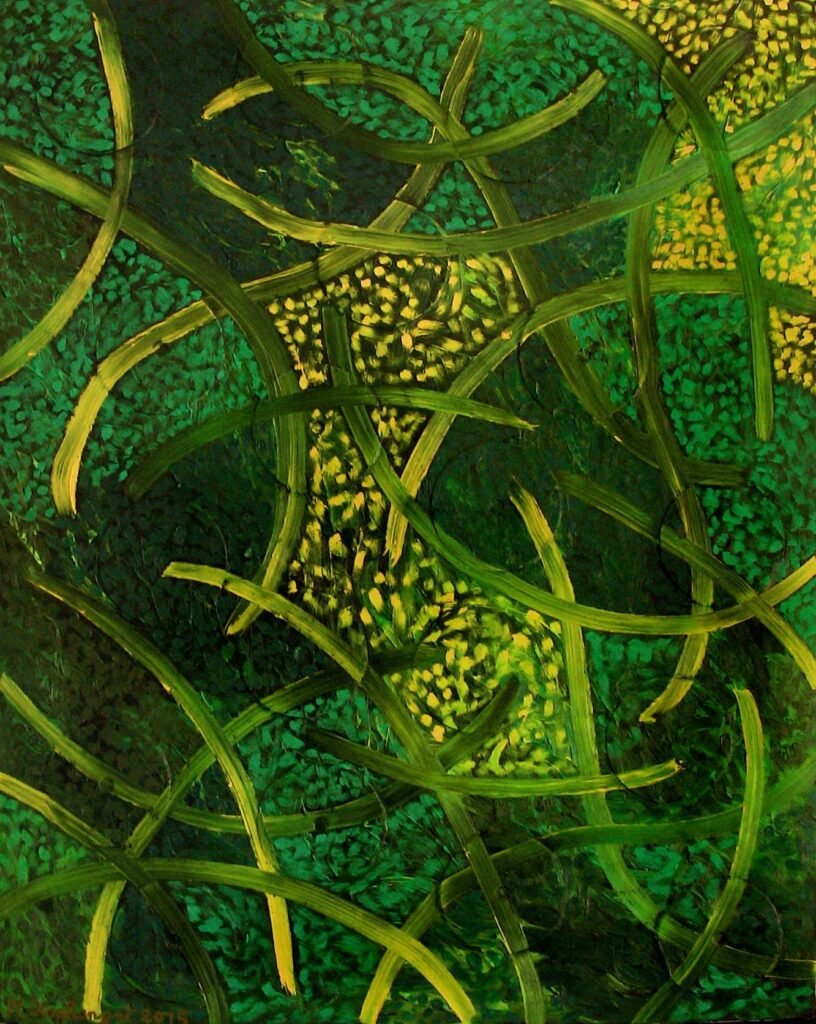
Kaphengst’s relationship to physical discipline runs through his biography and, eventually, into his method. As a child on Germany’s North Sea coast, he used soccer, tennis, and karate he holds a blue belt to build structure into an unstable home life; he still lifts weights and plays badminton. That same physical intensity resurfaces directly in his art during his acting training in Hamburg, where he developed real skill as a fencer. Inspired partly by Niki de Saint Phalle’s shooting paintings, he attached a paintbrush to the tip of a fencing foil, letting the choreography of a fencing match generate marks on canvas. The result, Fencing Pictures – Absolute Linearism, completed in 2009, collapses the distance between athletic gesture and painterly mark-making. The body doesn’t just make the work it performs it.
Performance, Stagecraft, and the Long Road Through Theater
Kaphengst’s artistic sensibility is inseparable from his years in performance. He interned in set design at the City Theatre Wilhelmshaven, took a small role in Der Schimmelreiter, trained as a media designer for image and sound in Hannover, and completed a three-year acting diploma between 2005 and 2008. For six years he worked with Blinde Passagiere, an ensemble of blind and sighted performers, taking on acting, theater education, and stage-building in equal measure. This immersion in staging, blocking, and production explains why studio materials like marking tape could so naturally migrate into his visual art for Kaphengst; the vocabulary of the theater and the vocabulary of the studio were never entirely separate.
Routine, Repetition, and Extreme Linearism
Independent theater rarely pays the bills, and Kaphengst supported himself for years as a bartender on the Reeperbahn, immersed in the district’s nightlife, its crowds, and its relentless cycles of desire and service. That environment sharpened an idea that had been forming since his Consumptive Surrealism years: that consumption isn’t simply a Pop Art subject but a linear process one built from routine, work, leisure, and repetition, and one that cannot be stepped outside of. In 2012, this thinking produced Extreme Linearism, his most physically demanding method to date. Working in intense, near-uncontrolled circular motions, he lets a pencil build an image entirely from line and repetition, with density, scale, and speed determining the emotional register of the final composition. It is the most direct fusion in his body of work between physical exertion and the line as a building block the culmination of ideas that trace back to a children’s drawing class and a childhood spent on a weight bench.
A Practice That Kept Moving
After around fifteen years in Hamburg, Kaphengst stepped back from the city, retraining as an instructor for continuing and adult education before relocating to the countryside. He has since worked as a tiler including on luxury cruise ships at Meyer Werft and as a public transit bus driver, all while continuing to develop his art. That range of working life, as unglamorous as much of it was, mirrors the material honesty at the center of his work: an insistence that lines, tape, cigarette packaging, and the body’s own movement are as legitimate a foundation for art as any conventional medium. His work has since traveled well beyond Germany, exhibited internationally in galleries and institutions across Europe and abroad proof that an artistic language built from the everyday can still travel far.
Want to explore more of Michael Kaphengst’s work and see his approach to Linearism in action? Follow him on Instagram: @michaelkaphengstlinearist