


Look at a Lib Mason painting before you know anything about it, and the first thing you’ll register is color, saturated, confident, almost decorative. It takes a second look to see what that color is doing.
The Grammar of Her Surfaces
Mason’s paintings are built using the Flemish technique: a grisaille underpainting establishes form, value, and light in monochrome, after which multiple transparent glazes are layered on top, letting color and luminosity build gradually rather than arrive all at once. Visually, this produces a very particular kind of surface, one where light seems to originate from inside the panel rather than bounce off its top layer. It’s a slow, deliberate way of painting, and it gives even a small panel a sense of density and glow that flatter, more direct color application can’t replicate.
This technical choice matters because of what Mason chooses to paint with it. Her subjects come from contemporary political, social, and environmental events, material that could easily be rendered bluntly. Instead, she uses beauty, symbolism, humor, and absurdity as visual strategies, building compositions designed to invite the eye in before the content of the image fully registers.
RIP ICE: Color as Camouflage
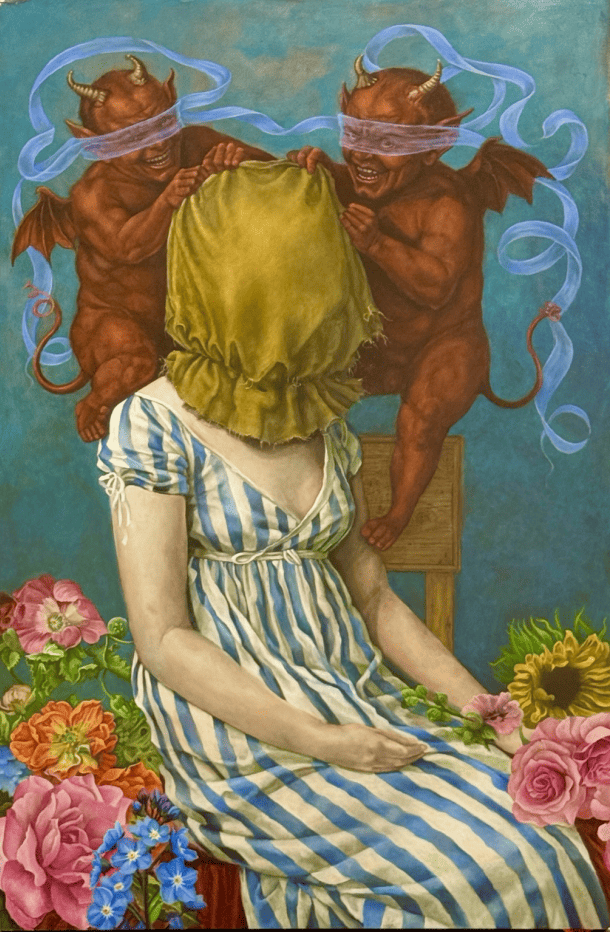
In RIP ICE, painted in response to the shooting of Renee Good, the palette is doing a very specific kind of work. Brilliant color and flowers surround the central action, two grinning, blindfolded devils pulling a hood over a seated woman, and that visual sweetness functions almost as camouflage, softening the viewer’s initial read of the scene. Look closer, though, and the composition reveals its structure: two symmetrical figures of menace flanking a single vulnerable one, their grins turning the act into something closer to sport than crime.
The woman’s skin is painted chalky, pale, and uneven, a formal decision that removes any specific racial or personal identity from her figure. Visually, this makes her read less like an individual and more like a stand-in; anyone could occupy that seat. The devils’ blindfolds are the composition’s most pointed detail: they’re actively engaged in an act of harm while visually unable to see the person they’re harming, a contradiction that gives the whole painting its unsettling charge. Beauty, symmetry, and color hold the scene together on the surface, while the underlying content pulls in exactly the opposite direction.
Esparza, Nadine and the Beautiful Wall: Absurdity as Composition
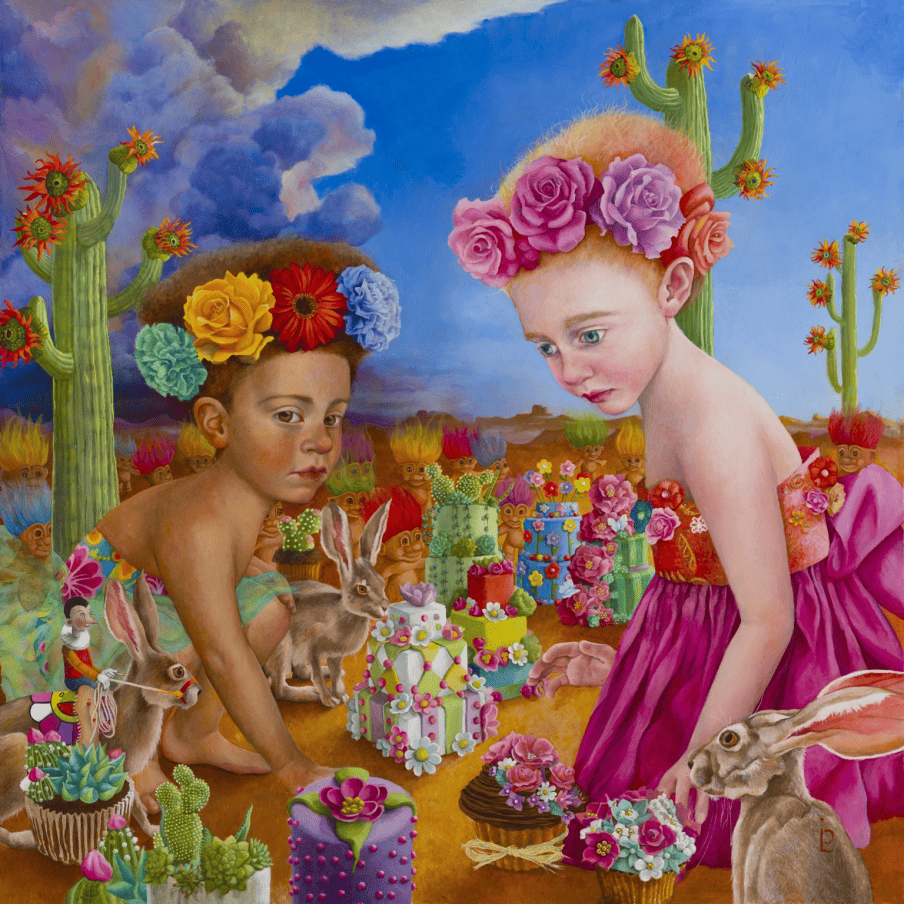
Where RIP ICE uses beauty to soften menace, Esparza, Nadine and the Beautiful Wall uses absurdity to defuse anger. Responding to the wall built between Mexico and the United States, Mason doesn’t depict the actual structure. Instead, two young girls occupy the center of the composition, engaged in building their own wall, made of cakes, meant to keep out trolls rather than people.
Visually, the painting trades the hard, straight geometry a real wall would suggest for the soft, rounded, layered forms of cake, tiers, frosting, curves. That formal softness is doing thematic work: it recasts the entire idea of a dividing structure through the visual language of play rather than defense. Pinocchio, positioned as a small witness within the scene, introduces a second visual thread about truth and deception, quietly present rather than emphasized. The overall effect is a composition that reads as playful before it reads as political, and the political reading, once it arrives, is sharpened rather than softened by that initial impression of innocence.
Flight: Restraint as Statement
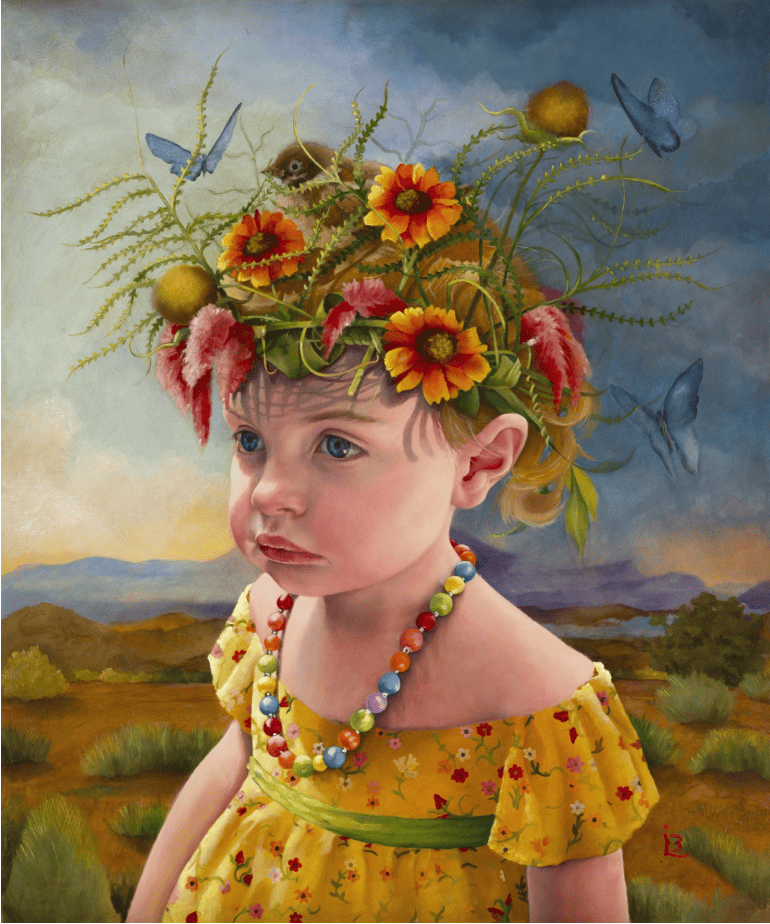
Flight is the most visually spare of the three works. A young girl stands alone in a barren landscape; there’s no crowd of symbolic figures here, no invented substitute object standing in for a larger issue. The composition relies on emptiness itself: negative space standing in for depletion, a single figure standing in for an entire generation.
What the painting withholds is as important as what it includes. There’s no literal depiction of climate change, no smokestacks, no rising water, no burning forest. Instead, the barrenness of the setting and the isolation of the girl carry the entire environmental argument, asking the viewer to fill in the causes while confronting the consequence directly.
A Consistent Visual Strategy
Across all three works, Mason’s compositions share a pattern: surface beauty or visual softness arrives first, difficult content arrives second, and the technique itself, slow, glazed, luminous, gives the viewer time to sit inside that gap. It’s a visual strategy built on delay, and it’s precisely that delay where each painting’s meaning ultimately settles.