
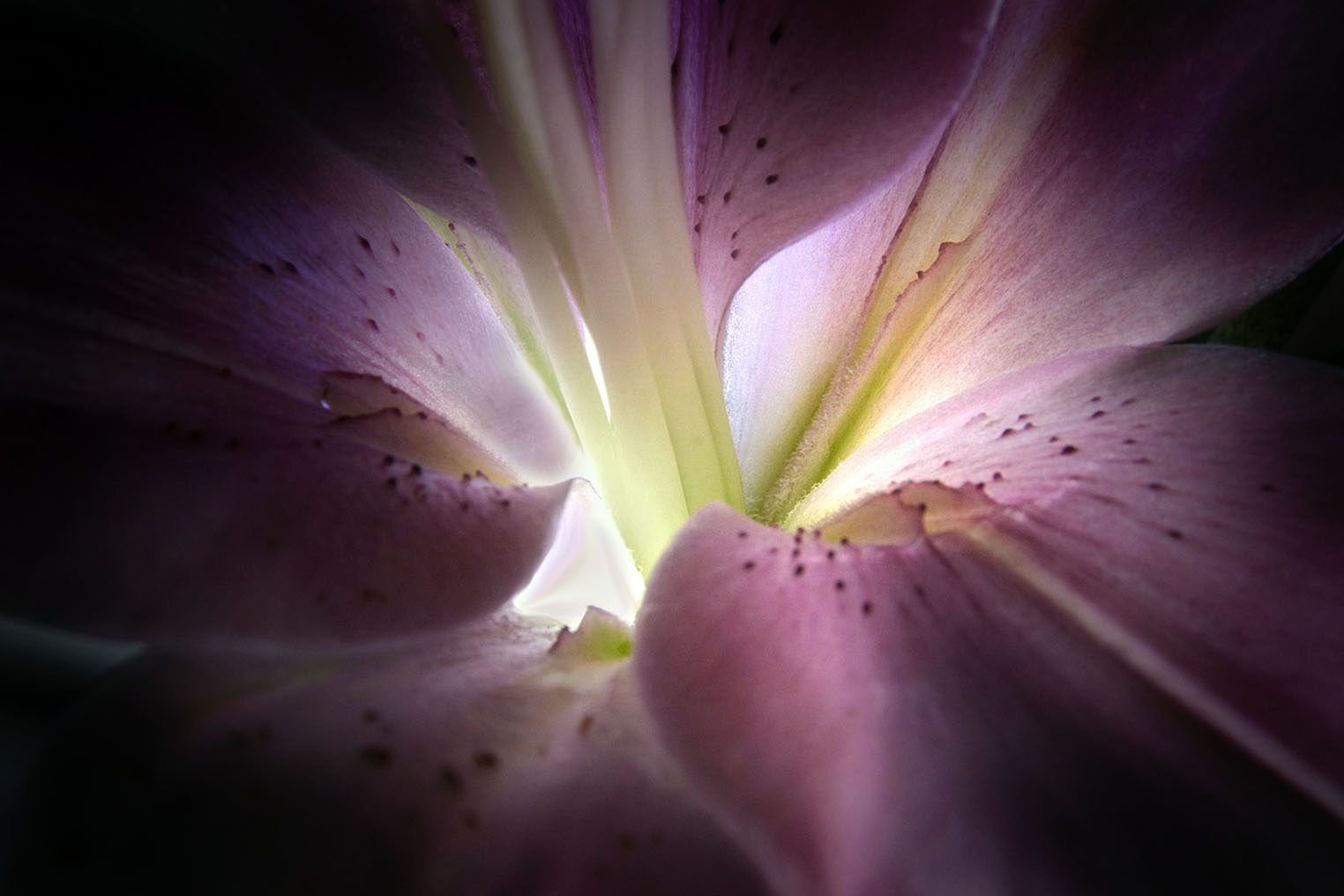



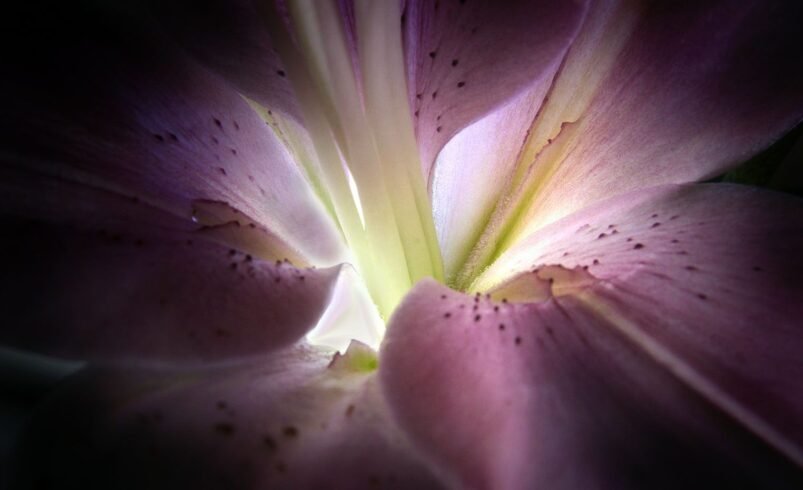
A welcome is an odd thing to photograph, since it is a gesture and not an object. It exists only between a host and a guest, and a picture can supply only one half of the exchange. Karel Fehr’s Welcome attempts it with light alone.
A Threshold Without a Door
The image is built around a glow. At its centre, a pale cream-yellow brightness opens like an aperture, and violet and pink forms fan away from it, flecked with fine dark markings. Toward the edges the frame darkens into shadow. Anyone who knows flowers will recognise the interior of a bloom, and the artist’s website describes the picture as an intimate corridor of light and shadow. The truth lies between the two readings, and the picture keeps it there.
That in-between status is where the work does its thinking. A threshold is the one place where a person is neither inside nor outside, and the photograph occupies a similar position with respect to recognition. The subject can be named, yet the composition does not ask us to name it. The converging petals behave as architecture, as walls leading toward a lit room, and the eye accepts the invitation before the mind has settled on what it is looking at.
Consider what the picture refuses to supply. There is no horizon, no ground and no marker of scale. The dark corners behave less like a background than like the walls of a room we have not yet entered, and the pale heart has the pull of a distant window at night. Ambiguity of space, here, is generous: it makes room for the viewer’s own projections.
Ambiguity of this kind is easily mistaken for vagueness. They are different things. Vagueness withholds information through carelessness, while ambiguity withholds it with precision, so that more than one meaning remains available. Welcome is precise about where its edges fall.
The Grammar of Gradation
What makes the passage feel hospitable, rather than merely strange, is the tonal handling. The transitions from bright centre to dim periphery are gradual, without hard borders, and the official text points to precisely this: the gentle gradation of tones and the delicate play of light. There is no moment at which the picture turns harsh.
It is worth recalling that Edmund Burke, in his eighteenth-century treatise on the sublime and the beautiful, associated beauty with smoothness and gradual variation, and set it against the abrupt and the overwhelming. Fehr’s picture sits firmly on the beautiful side of that old distinction. Its darkness is not a threat but a surrounding, a shadow in which the light can be seen to better effect.
Shadow plays an unexpected role in this. We tend to read darkness as absence, but in Welcome it is the frame that makes brightness readable. A glow with no surrounding dark would be mere glare. The darkness, in other words, is the host’s quiet contribution, the thing that allows the light to be received as warmth and not as exposure.
The result is an emotional experience that does not rely on narrative or on a legible subject. Light moves from a source toward the viewer, shadow absorbs the margins, and a feeling of being gently drawn forward arises from the arrangement alone. The photograph generates mood the way a chord generates mood, through relationship and not through reference.
Warmth in a Cold Genre
Abstraction has a reputation for austerity. Much of it is cool, analytic, wary of comfort. The official text notes that Welcome stands as a beacon of warmth within the often cold expanse of abstraction, and the observation is fair. The glow here is not clinical. It has the colour of lamplight, and the surrounding violet softens it further.
There is a relevant, modest fact about how this kind of image travels. The musician Chris Hinze states on Karel Fehr’s website that he incorporated Fehr’s photographic art into three of his musical compositions, drawn by a sense of shared emotional depth and thematic essence. That is the extent of what is documented, and it should not be inflated into more. But it does suggest something about pictures like Welcome: that an image can carry feeling without carrying a story, and that such feeling can be borrowed by another art form without translation.
What Remains Unsaid
Commercial photography, the field in which Fehr spent over forty years, is a discipline in which an image almost always has a task. It sells, explains or reassures. Upon retiring he moved toward photographic art and the freedom to leave things unresolved, and Welcome is a quiet instance of that freedom. It has a task, but it is not a commercial one. Its task is to hold a door open.
The photograph does not tell us what lies beyond the light, and the restraint is the point. A welcome that explained itself would be a lecture. One that simply glows, and leaves the guest to decide whether to step forward, is closer to hospitality, and closer to what abstract art, at its best, can offer: a space in which looking becomes a kind of arrival.
Karel Fehr’s complete gallery can be browsed at karelfehr.com.