
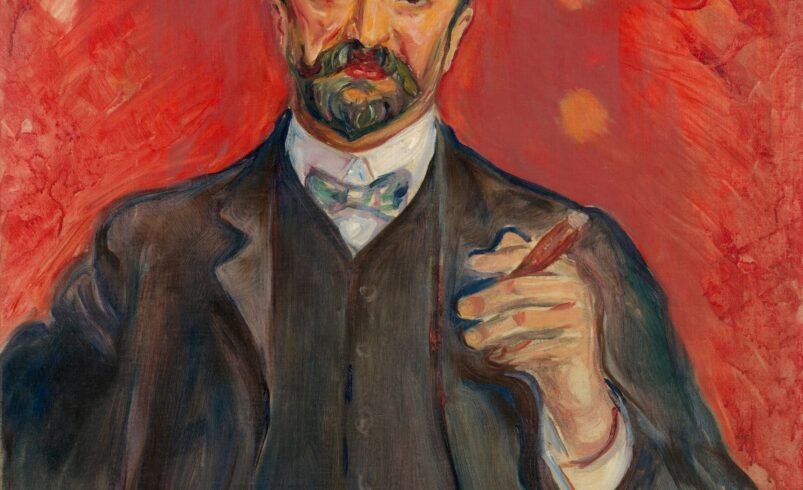
A show at London’s National Portrait Gallery reveals the artist’s astonishing technical skills, but the wall texts are laugh out loud amusing at best and art historically dangerous at worst.
LONDON Norwegian painter Edvard Munch is almost a byword for his over reproduced representation of psychological torment known as “The Scream” (1893). Its grimacing visage and loose, swirling brushwork rendered in a glaringly contrasting palette of saturated orange and blues have seeped into our collective cultural impression of him.
It is fascinating, then, that the National Portrait Gallery’s (NPG) chronological survey of his portraits reportedly the first of its kind in Britain reveals an astonishingly accomplished and varied range of technical skill, capable of expressing an equally diverse range of psychological characters and moods. It is a shame that the wall text interjects with overenthusiastic interpretative assertions, which are laugh out loud amusing at best and art historically dangerous at worst.
One may be surprised to learn that Munch produced hundreds of portraits, and the number on display here is generous. The range of skill and experimentation is evident from the start. In an early self-portrait from 1882, when the artist was 19 years old, and a portrait of his friend and landscape painter Jørgen Sørensen from 1885, Munch used a more traditionally representational form of faceted modelling delineating the contours of forms into shaded areas to create depth and dimension, with naturalistic tones of muted earth and light. A nearby 1886 study of his brother, on the other hand, is a hard edged linear work characterized by tonally lighter, more saturated block colour; a depiction of his sister in “Evening” (1888) dispels of facets for a more dappled application. Throughout all is a keen understanding of light.
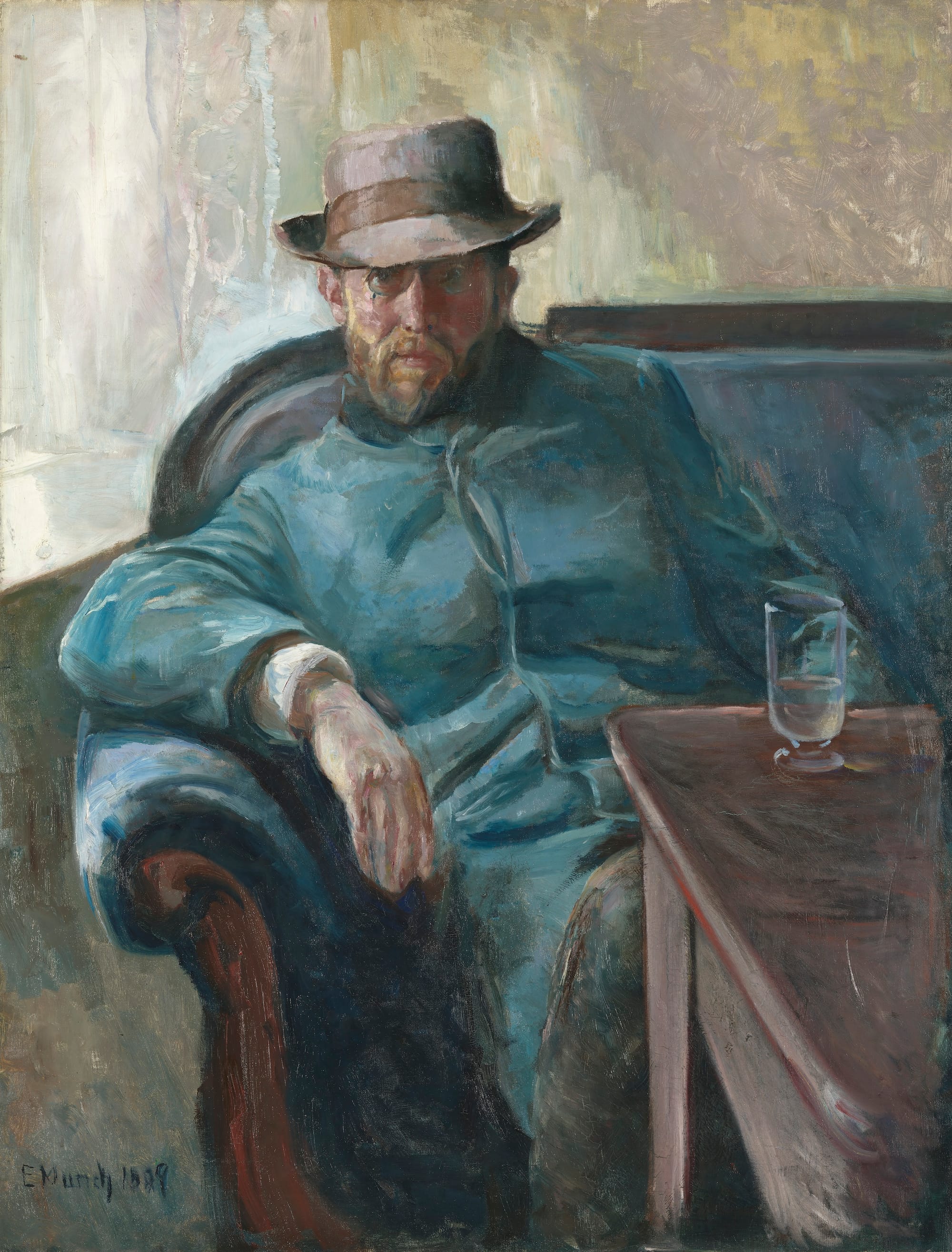
We progress chronologically to Munch’s time fraternizing with bohemian characters in Kristiania (now Oslo), Paris, and Berlin and experimenting simultaneously with lithographs. Here, the swirling, caricatured faces are outlined in single egg like swoops — such as in his etching of bar punters in “Kristiania Bohemians II” (1895) sit next to portraits made seemingly of nothing but loose hatching with little care for accurate representation, as in “August Strindberg” (1892). These friends were clearly at the forefront of decadent thinking; Munch’s 1889 portrait of the writer, anarchist, and proponent of sexual freedom Hans Jaeger needs no further explanation as this louche, petulant figure slouches in a murky, smoke filled café.